Vapofil Official Website › Blog › Twenty Milligrams Of Boron Is One Milligram
Twenty Milligrams Of Boron Chelate Is One Milligram Of Boron
A percentage on a mineral line changes the dose by a factor of twenty, and it is printed in smaller type than the number it modifies. This is the arithmetic, why it is easy to get wrong, and what the published work actually used.
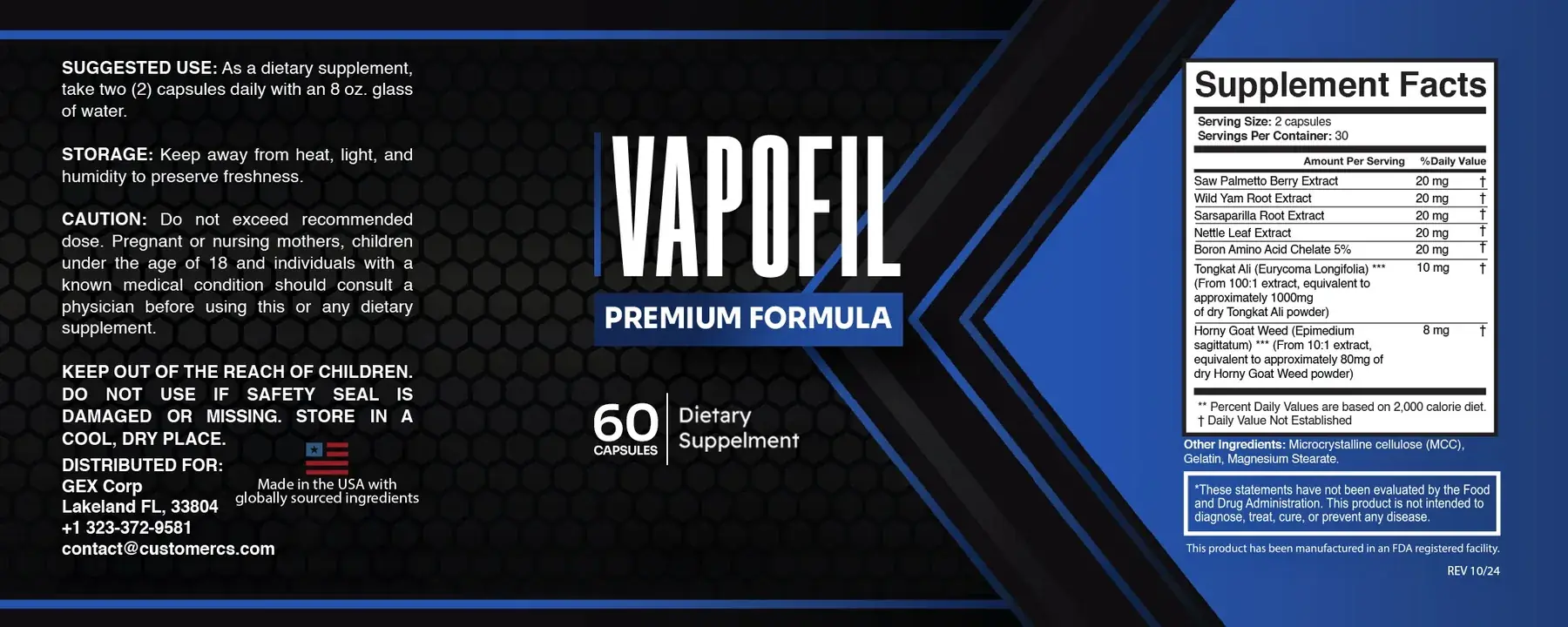
- A chelate is a mineral bound to a carrier. The label weight is the whole thing.
- The percentage is the mineral. Five per cent of 20 mg is 1 mg.
- Published work on boron uses ELEMENTAL figures, so convert before comparing anything.
- The studies that reported a hormone change supplemented 3 mg of boron a day against a boron-poor diet.
What a chelate is and why it exists
Minerals in their raw salt form are not always well absorbed, and some of them are hard on the stomach. A chelate binds the mineral to an organic carrier, usually an amino acid, which changes how it moves through the gut wall. The resulting compound weighs considerably more than the mineral inside it, because the carrier is most of it.
That is why a chelate line always carries a percentage. Without it the weight would be meaningless: twenty milligrams of a compound tells you nothing about how much of the interesting element is in there. With it, the arithmetic takes five seconds.
None of this is a trick. It is the standard way to declare a chelate and it is what a careful label looks like. The problem is purely that the percentage is small, quiet, and printed beside a number twenty times larger.
| What the line says | What it means | The number to use |
|---|---|---|
| Boron Amino Acid Chelate | Boron bound to an amino acid to aid absorption | — |
| 5% | Five per cent of the weight is elemental boron | The multiplier |
| 20 mg | The weight of the whole chelate in a serving | Multiply this by 5% |
| Result | The elemental boron in a serving | 1 mg |
Twenty milligrams of a 5 per cent chelate is one milligram of boron and nineteen milligrams of carrier. Reading the first number as the dose overstates it twentyfold.
The arithmetic, written out
Twenty milligrams multiplied by five per cent is one milligram. The other nineteen milligrams are the amino acid carrier, which is not boron and is not doing anything interesting.
So the boron in a serving of this product is 1 mg. That is the figure to write down and the figure to carry into any comparison with published work. A reader who takes the 20 mg at face value is out by a factor of twenty, which is larger than most of the differences anybody argues about in this category.
- Find the mineral line and the percentage beside it.
- Multiply the printed weight by the percentage.
- That result is the elemental amount. Use it, and nothing else, for comparisons.
- If no percentage is printed, the label has not told you the dose and you cannot work it out.
What the boron studies actually used
The USDA depletion and repletion experiments are the studies behind almost every claim made about boron and hormones. Their design matters as much as their result. Volunteers were first fed a deliberately boron-poor diet, supplying about a quarter of a milligram per 2,000 kilocalories, for a period of weeks. Then 3 mg of boron a day was added.
In the first of those studies twelve postmenopausal women went through that sequence for 119 days of depletion and 48 days of repletion. Supplementation reduced plasma calcium and urinary calcium and magnesium excretion, and raised serum 17-beta-estradiol and testosterone. Later experiments in the same programme, including one with five men over 45, looked at copper status, superoxide dismutase and ceruloplasmin.
Two things follow. The supplemented amount was 3 mg, three times what a serving of this product carries. And the effect was measured against a depleted baseline, which is not the state most people eating ordinary food are in.
The 2018 review of boron in human physiology is the better place to read the wider picture, covering bone metabolism, inflammatory markers and hormone signalling across the literature rather than one programme.
| Source of boron | Daily amount | Context |
|---|---|---|
| This panel | 1 mg | From 20 mg of a 5 per cent amino acid chelate |
| The USDA depletion studies | 3 mg | Supplemented against a deliberately boron-poor diet of 0.23 to 0.25 mg per 2,000 kcal |
| An ordinary mixed diet | About 1 to 2 mg | Fruit, nuts, pulses and vegetables are the main contributors |
The capsule adds roughly what a normal diet already supplies. That is a reasonable thing for a supplement to do and it is not the same as a studied dose.
The Vapofil panel with every number converted
The chelate read as elemental boron, both extract ratios read as extract, and each of the seven lines set beside the dose its own research used.
One bottle $89 · six bottles $294 · 60-day money-back guarantee
Order Vapofil On The Official WebsiteTwo capsules a day · 60 per bottle · lot VAP-26/GO-6809
Why this error spreads so easily
Because it is invisible unless you are looking for it. A page quoting 20 mg of boron is not lying about the label, which does print 20 mg. It has simply dropped four characters, and the resulting sentence reads perfectly well.
It also spreads because it flatters. Twenty milligrams of boron would be an unusually large amount and would make a product sound seriously dosed. One milligram sounds like what it is, which is a sensible top-up.
And it spreads because nobody corrects it. The 2024 systematic review of testosterone boosters went through 52 studies covering 27 marketed ingredients and found most fail to raise total testosterone at all. In a field where the underlying evidence is that thin, a twentyfold error in a dose figure is rarely the thing anybody is arguing about.
- The label is accurate. The error is in reading it.
- The percentage is always printed. It is just small.
- A page that quotes the chelate weight as the dose has probably not read the panel carefully, which tells you something about the rest of that page.
- The same reader error applies to any chelated mineral on any supplement.
The same check on any other mineral
Zinc picolinate, magnesium glycinate, iron bisglycinate, chromium picolinate and copper gluconate all behave the same way. Each is a mineral bound to a carrier, each is declared by the weight of the whole compound, and each carries a percentage that does the real work.
The percentages vary a great deal. Zinc bisglycinate runs around 25 to 30 per cent zinc. Magnesium glycinate is closer to 14 per cent magnesium. Boron amino acid chelate is commonly 5 per cent, as here. A reader who knows to look for the number will not be caught by any of them.
Some labels declare the elemental amount directly and put the chelate weight in brackets, which is clearer and less common. Either format is fine as long as you know which number you are reading.
What the percentage still does not tell you
Converting the weight gets you the elemental amount and it stops there. Three further things a chelate line does not say, and none of them is a criticism of this label specifically, because almost no label in the category says them either.
It does not say which amino acid is the carrier. Glycine, aspartate and a generic protein hydrolysate all appear in commercial boron chelates and they are not identical materials. A label reading amino acid chelate has told you the class and not the compound.
It does not say how much is absorbed. A chelate exists to improve absorption relative to an inorganic salt, and the size of that improvement varies by mineral, by carrier and by what else is in the meal. Absorption is measured in a study rather than asserted on a panel.
And it does not say what the rest of your intake looks like. Boron comes largely from fruit, nuts, pulses and some drinking water, so two people taking the same capsule can be at meaningfully different totals. The 2018 review of boron in human physiology is the better place to read about the range of ordinary intakes than any product page, including this one.
- The carrier is named as a class rather than a compound on most chelate lines.
- Absorption is a property of a study, not a property of a percentage.
- Dietary intake sits underneath any supplement and it is rarely zero.
- None of those three is knowable from the panel, and a page claiming otherwise is guessing.
Is one milligram worth having?
Probably, as part of a diet, and not as a replacement for the studied dose. An ordinary mixed diet with fruit, nuts and pulses in it supplies roughly one to two milligrams of boron a day, so a capsule adding another milligram is a modest and defensible top-up rather than a therapeutic intervention.
What it is not is the 3 mg the depletion studies supplemented, and it is certainly not the 20 mg a misread label would suggest. Anyone choosing a product because of its boron content should be working from the elemental figure, and on this panel that figure is one milligram.
The wider point is worth keeping. A panel that prints a percentage is giving you the tools to check it. A panel that buries a mineral inside a proprietary blend is not, and no amount of arithmetic will get the number out.
Multiply the printed weight by the printed percentage, and use only that result when you compare a supplement against a study.
References
- Nielsen FH. Biochemical and physiologic consequences of boron deprivation in humans. Environ Health Perspect. 1994;102 Suppl 7:59-63. PMID 7889883. https://pubmed.ncbi.nlm.nih.gov/7889883/
- Khaliq H, Juming Z, Ke-Mei P. The Physiological Role of Boron on Health. Biol Trace Elem Res. 2018;186(1):31-51. PMID 29546541. https://pubmed.ncbi.nlm.nih.gov/29546541/
- Morgado A, Tsampoukas G, Sokolakis I, et al. Do "testosterone boosters" really increase serum total testosterone? A systematic review. Int J Impot Res. 2024;36(4):348-364. PMID 37697053. https://pubmed.ncbi.nlm.nih.gov/37697053/
- Kuchakulla M, Narasimman M, Soni Y, et al. A systematic review and evidence-based analysis of ingredients in popular male testosterone and erectile dysfunction supplements. Int J Impot Res. 2021;33(3):311-317. PMID 32358510. https://pubmed.ncbi.nlm.nih.gov/32358510/